
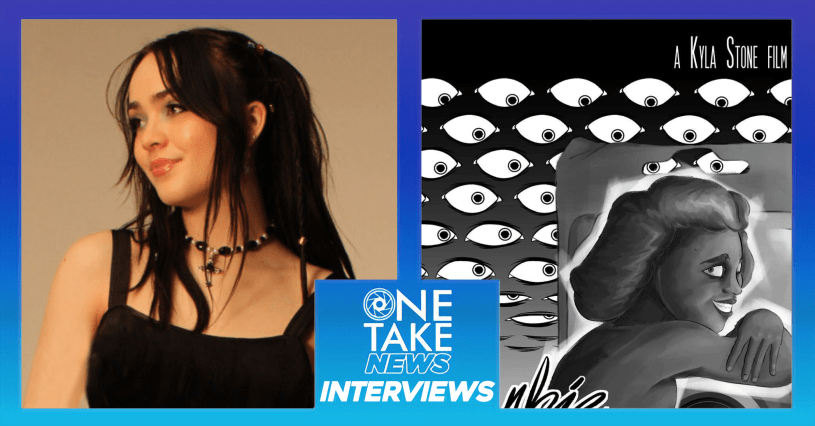
The TIFF Lightbox is home to many incredible opportunities and is widely seen across the Toronto film community as something like a gathering base for everyone who loves film. Not only do the latest and greatest stars premiere their films there, but young rising stars do as well. TIFF has partnered with Toronto Metropolitan University to showcase 3 new films from first-year students at the Lightbox and One Take News had the opportunity to speak to one of the directors presenting at this event, Kyla Stone. We asked about her inspirations for Barbie and Me, what she learned as a director, her excitement for premiering the film at the TIFF Lightbox, and more. Check out our full conversation!
OTN: This film has so many cool ideas in it so I’m curious, could you tell me what inspired some of them?
K.S: Well, we were given the opportunity to shoot on 16mm and I knew that I wanted to make something that had that old feel in a modern sense. New commercials these days are way more subtle when it comes to their marketing and playing on your problematic insecurities. Older marketing isn’t as subtle so I thought it would be cool to tinker with that and incorporate that old commercial feel to the current stress of today’s pressures.
OTN: You might’ve answered my question already but were you given the option to shoot in the 16mm format or was that a requirement?
K.S: For first year, we are required to shoot on the Bolex for everything.
OTN: Would you have used something other than the Bolex if you had the option?
K.S: It turned out well this way…but I hated the Bolex. It was not a fun medium to work with. When [the film] turns out, it turns out and it’s awesome but working with it is really difficult. A lot of my film, actually, turned out wrong because the cameras are really old. So, lots of the film got messed up. Everything shot on one of the particular lenses didn’t work. So, I really had to cut around what I could and couldn’t use. It worked out for the best and added to the aesthetics of the film. But it was really difficult and stressful to work with.
OTN: You mentioned that some of your film was destroyed. Because of that, did you end up reshooting anything or just work with whatever was salvaged?
K.S: Unfortunately, no. With the Bolex, shooting more means more money for film and then even more money to develop the film. I just worked with whatever I had. Initially, I didn’t think the film would go anywhere. It was just a school project I wanted to get done. I obviously wanted it to be nice and something I am proud of but I was on a timeline, had a budget and I just had to work with what I had. I’m glad I did because honestly, some of the problems with the film actually made it really unique.
OTN: Like you mentioned, film is really expensive so you have the make the most of it on a budget and I really like what you did with the one minute runtime. Was it always the plan for it to be one minute or was that a requirement? To add on to that, if you had more time, would you have added more or are you happy with it?
K.S: It was always gonna be 1-2 minutes. We shot on 3 minutes of film and with the cuts, edits, etc, it was always gonna be in that range. I think if I had a little bit more time, I would have added more of a proper ending. I felt it ended on a…I wouldn’t call it anti-climactic but it kinda just ends. I think it works because [Barbie and Me] is more of a thinker rather than a “feel this way!”, now “feel THIS way!” film. But yeah, just would’ve added a better ending.
OTN: I know I told you this already but I absolutely LOVE the sound design of Barbie and Me.
K.S: Thank you!
OTN: I love the way the sound got steadily louder leading up to the end and the way it was mixed. Can you please tell me, from a production standpoint, what you had to do to create that sound and your inspirations?
K.S: Because all the visuals took work, I knew I had to tie it together with sound and honestly, the prompt with the film was sound design. So, with that in mind, I wanted to have the reoccurring camera to add on to that pressure and anxiety. The sound was meant to put you in the head of the character. It’s meant to be a “POV: You are experiencing the sounds as the character is experiencing it” and I really wanted. it to do that. I feel I accomplished that, especially with the visuals, the blur, how she’s experiencing things, etc. That’s kind of how thought to do that and it was just less diegetic and more how would she be feeling in this moment or how would she be hearing, getting louder, does it feel overwhelming, etc. I wanted the sound to feel increasingly more full until there was no sound left to think/imagine.
OTN: You mentioned that using the Bolex was challenging because the film kept getting destroyed. But as a director, was there any other challenges you faced on set and if so, how did you overcome them?
K.S: Um, well my actor didn’t show up on set. We had a set amount of time to have the space because we technically weren’t allowed to film in the photo studio since we’re not photo students. Being a film student, I hit up a photo student and they were kind enough to book it for me. But since they booked it, they had to sit with us while filming so we were wasting their time too. An hour an a half into the shoot I’m panicking because nobody knows where this guy is. They eventually came though. But yeah, it was mainly working with the space I had and working with the lights we had. Since they’re very old and I wasn’t used to working with black and white, that was a challenge. I was having a hard time knowing how to light the set, different color temperatures as well as the ISO for the film. It’s not great so you have to very harshly. It was a bit of a different approach than filming on digital so I struggle with that a bit. I was honestly just trusting my eye and if it looked good for my film and the experience. I just learned to go with my gut a lot. There’s no monitor to look through.
OTN: Speaking of black and white, the way it’s filmed always fascinated me. Could you tell me a bit about how that factored into your choices for props, colours of costumes, etc. in order to bring your vision to light?
K.S: Yeah, that really matters. There’s no colour temperature to work with on the Bolex.It comes down to how deep your blacks and shadows are. I wanted her to be wearing all black and I had an all white background so I wanted high contrast. I didn’t do this but you see this in old films a lot. Sometimes, they paint the actor’s face to give more contrast.
OTN: There’s a scene about that in Babylon, I know exactly what you’re talking about!
K.S: Oh cool! But yeah, you kind of just have to mind things like that where it’s not gonna look the same on black and white like it would on digital. You can mess around with colours. If I remember correctly, some of my shots with different, lighter colours, I lit with a bit more blue. It showed up, not blue obviously, but it was still not as harsh coloured as the direct light. It’s little things like that where you gotta mind what you’re doing. You also gotta mind the costuming a bit. It might clash or blend together if your actors are wearing the exact same shade and are near each other. It’s not great but [black & white film] is a fun medium.
OTN: You’re in film school so you’re obviously learning new things with every movie you make. For Barbie & Me, what do you feel was the biggest lesson you learned working on this film and the one you’re gonna apply the most to future films?
K.S: Honestly, just go what you’re given. When the film got messed up, I treated it as a lost cause. I went through the whole “this is terrible, I’m gonna hate this” thing. But in the edit, I fixed it and made it something I liked. It added a charm I wouldn’t have thought to add to the movie. So, I learned to not give up on your pieces and just follow it through to the end. It’s really what I’m gonna take away from this experience.
OTN: That’s awesome. I really like to hear that and I like your film even more knowing what happened and how you made it. I thought your final film was your final vision but knowing what I know now, I’m so impressed. On another and more exciting note, your film is gonna be premiering at the TIFF Bell Lightbox this week (EDITOR’S NOTE: This interview was conducted a few days before the premiere of Barbie & Me) so I gotta as, how are you feeling about that right now? Are you nervous, excited for people to see this, what’s going through your head?
K.S: I feel like it hasn’t completely hit me yet. Initially I was like “oh this is cool” but now I’m realizing how cool this is and how big of an opportunity this is. Now I’m at the point where I’m freaking out and also excited. I have all my friends coming to see it but yeah, it’s awesome. Me and the other two TMU people who were selected were talking about it and realizing how big of a deal this is. We’re gonna get our name out there and hopefully this lets us start working on other things soon. Not to mention that it looks good on a résumé.
OTN: Do you think you’re ready for people to see Barbie & Me?
K.S: I’m very nervous. I’m one of those people who doesn’t like to watch their own work. Now, I’m gonna watch everyone else watching me. I hope they like it and if they don’t, that’s totally fine too. Everyone has their own opinions, art is subjective. I feel like I’m ready for this. I’m so excited!
OTN: What are you hoping the audiences take away from this?
K.S: With all my films, I really want people to take their own experiences, put it into the film, and create their own opinion from that. I have my own feelings towards Barbie & Me and what I want to get out of it. But, I also really want for people to be able to put their own experiences into the film and take what they want out of it. I hope Barbie & Me is relatable enough for people to create their own thoughts, feelings and opinions on the meaning behind it.
OTN: That’s a great way to end it. Thanks for taking the time to talk to me, I really appreciate it!
Barbie & Me had it’s premiere at the TIFF Bell Lightbox last week. The film is currently not out but we expect it will be soon!
 One Take News