
At long last, ‘Salem’s Lot is finally here. Amid rumors of the film being cancelled after being pulled from its theatrical release over two years ago, it’s finally hitting Max/Crave in a week’s time. As the first true film adaptation of Stephen King’s beloved vampire novel, ‘Salem’s Lot has high expectations to live up to given the great success of the original 1970’s adaptation and the book. So, with all the drama surrounding the post-production, what is the verdict? It’s pretty good. Like many of the decisions Warner Bros. has made recently, I have no idea why ‘Salem’s Lot got dumped onto a streaming service when it could have done well in October when horror thrives at the box office.
The cast is excellent, and for me, the best part of this film. Dauberman’s King adaptations have always had good casts and this is no exception. Fresh off the success of Top Gun: Maverick and nabbing high-profile roles like Sentry in Thunderbolts*, Lewis Pullman is fantastic as Ben Mears, playing the charming, brave, and curious author who returns to his childhood home to write a book. He’s the essence of a “cool” character and a joy to watch on screen. Standouts from the rest of the ensemble include Bill Camp, as the local schoolteacher, Pilou Asbæk as a vampire’s human companion, Alfre Woodard as Dr. Cody, and child actors Jordan Preston Carter, Nicholas Crovetti, and Cade Woodward. Each member of the cast knows their job and fully delivers.
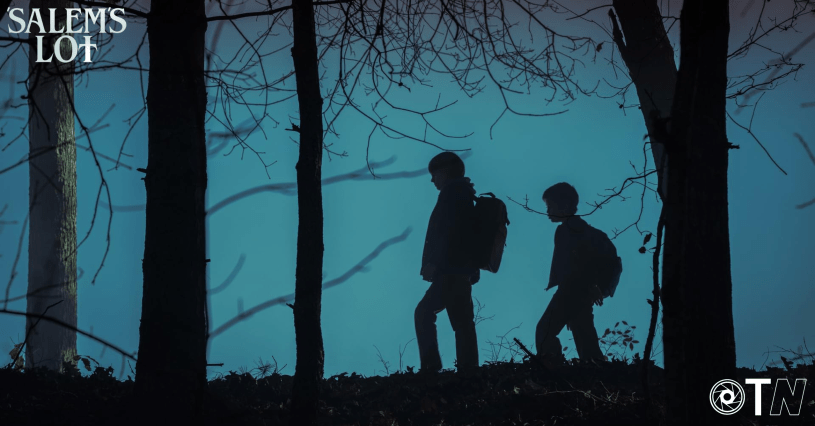
Production-wise, it was very obviously meant to be a film with theatrical release. The sets are sprawling and give the town of Salem’s Lot a real feel as if this was indeed a real town in Maine. Cinematographer Michael Burgess, a frequent collaborator of producer James Wan and Dauberman does a stunning job bringing life to this film. This is best exemplified in the scene where the Glick boys are attacked. The scene is lit with a blue-to-purple-magenta gradient behind a forest, and the only way you can see anything is in the form of silhouettes. It’s the perfect example of how key lighting can be impactful and artistic when used properly. The costumes and effects are also pretty good.
Scripts are often the weak link in horror movies. They’re usually full of tacky characters, and corny dialogue and fall into horror tropes and archetypes. Luckily, ‘Salem’s Lot doesn’t fall into that trap. Dauberman wrote the two It movies, which were very well received by critics and audiences. In this film, his writing is a fairly faithful adaptation of the story. The themes of grief, trauma, abuse, and evil are as prominent as ever and help with the underlying story. Everything feels well-paced and at no point do you feel things are dragging or overstaying their welcome.
If I’m going to nitpick one thing about this film, it’s the use of Kurt Barlow, a vampire in the film and the main antagonist. I did not like the choice to keep Barlow hidden in the shadows during his predominant moments on screen with quick cuts or a flicker of his eyes here or there. It was ok at first but got more and more frustrating as the film progressed. I prefer to see my antagonist in full force throughout the movie as opposed to just a few moments at the end. When we finally see Barlow, he’s a bit of a letdown. Barlow, played by Alexander Ward as we exclusively reported over two years ago, looks a bit CG-heavy to me compared to the rest of the movie, and that took me out of it a bit. His design isn’t BAD by any means, but I was hoping for more after seeing how antagonists in other King adaptations, mainly Pennywise, have been depicted recently.
‘Salem’s Lot is another win for Stephen King fans. Thanks to solid direction, an eerie atmosphere, and a strong performance from Lewis Pullman, it will make you wonder why it didn’t end up getting its original theatrical release.
 One Take News