
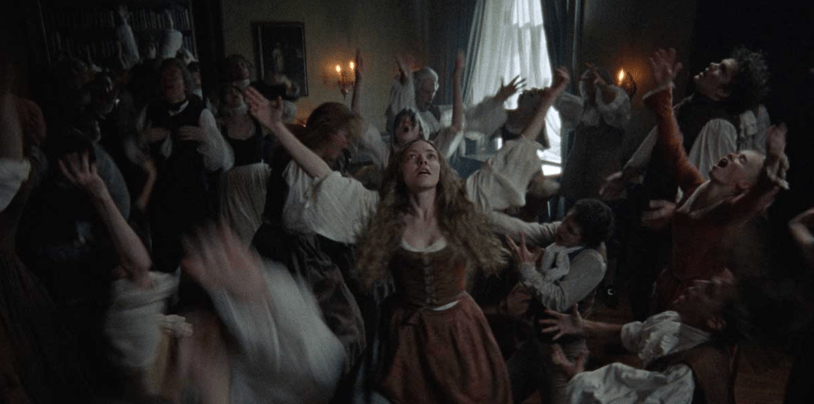
The Testament of Ann Lee is a rare cinematic experience: part historical drama, part musical, and wholly audacious. Director Claire McCarthy dives into the life of Ann Lee, the founder of the Shaker movement, with a vision that refuses to simplify, sanitize, or sentimentalize her story. The result is a film that is as challenging as it is enchanting, a work that exists on the knife-edge between devotion and obsession, revelation and disorientation.
Amanda Seyfried delivers the kind of transformative performance that commands attention without ever begging for it. As Lee, she embodies fervor, intellect, and vulnerability, walking a tightrope between saintly charisma and human frailty. Seyfried’s performance captures Lee’s mystical certainty alongside her private doubts, creating a character who is both inspirational and relatable. Every note of her singing, every flutter of her expression, suggests a woman fully committed to her calling — and aware of the sacrifices that accompany it.
The film’s ambition extends to its structure and visual style. Scenes shift seamlessly between intimate indoor gatherings and wide, awe-inspiring landscapes, underscoring the tension between community life and the expansive spiritual visions that drive Lee. Cinematographer Natasha Braier frames Shaker meetings with a reverence that borders on ritual, often using symmetrical compositions and natural lighting to evoke a sense of divine order. Musical sequences, far from being mere spectacle, are integrated into the narrative as expressions of devotion and emotional catharsis. Choral arrangements swell and recede with the characters’ internal states, turning worship into narrative propulsion.
McCarthy does not shy away from complexity. The film acknowledges that the Shaker life demanded profound personal sacrifices, especially from women, who bore the brunt of communal labor while adhering to strict moral codes. The Testament of Ann Lee is as much about the psychology of faith as it is about the history of a movement. Doubts, tensions, and rivalries are present, but the film treats them as intrinsic to belief rather than as melodramatic friction.
Where the movie may divide audiences is its rhythm. McCarthy allows sequences to linger, favoring observation over exposition. There are moments where narrative momentum stalls, intentionally drawing the viewer into the contemplative, measured pace of Shaker life. For some, this may feel slow or indulgent; for others, it reinforces the immersive quality of the world she is constructing. Patience, as it turns out, is part of the reward.
Thematically, the film wrestles with ideas of authority, devotion, and the limits of vision. Lee is both a product of her time and a woman ahead of it — a figure who commands loyalty without coercion and inspires obedience without violence. Her story is inherently paradoxical: a tale of liberation bound by ritual, of inspiration constrained by communal expectation. McCarthy handles these contradictions with nuance, neither romanticizing nor demonizing Lee’s choices.
Musically, the film is audacious. Choral arrangements, solos, and layered harmonies act as both narration and emotional landscape. The score heightens the spiritual intensity without tipping into melodrama, creating moments that are transcendent, unsettling, or unexpectedly intimate. The music is never ornamental; it is essential to the emotional architecture of the film.
The Testament of Ann Lee is not casual entertainment. It asks for attention, for patience, and for openness to a sensibility far removed from contemporary storytelling norms. But the rewards are substantial: a portrait of conviction, artistry, and humanity that lingers long after the credits roll. Ambitious, immersive, and musically radiant, The Testament of Ann Lee is a historical musical that challenges, enchants, and elevates its audience.
 One Take News