
The Testament of Ann Lee is one of the boldest movie musicals in recent memory. Rather than treating Ann Lee’s story like a conventional historical biopic, director Claire McCarthy embraces something far more ambitious, blending history, spirituality, music, and movement into an experience that feels wholly original. It’s a film that refuses easy answers, asking audiences to sit with faith, doubt, conviction and contradiction all at once. The result is a film that is both emotionally stirring and artistically fearless, one that lingers long after the credits roll.
Amanda Seyfried delivers what may be the best performance of her career. She portrays Lee with remarkable conviction, finding the humanity beneath the religious iconography without ever reducing her to a simple historical figure. Whether she’s leading worship through song or navigating quieter moments of uncertainty, Seyfried brings an emotional honesty that grounds even the film’s most surreal sequences. It’s an incredibly demanding role, and she carries the weight of the film with quiet confidence from beginning to end. Every glance, every lyric and every measured pause feels purposeful, allowing Lee to exist as both an inspiring spiritual leader and a deeply vulnerable woman.
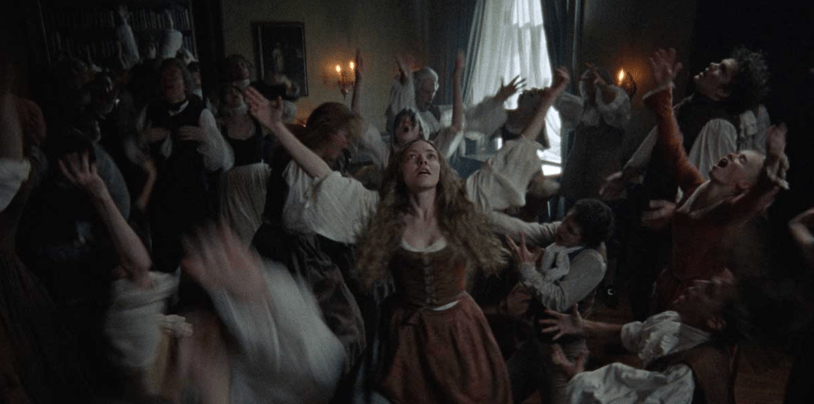
The film’s visual language is just as striking as its performances, but what truly sets it apart is its choreography. Rather than functioning as traditional musical numbers, the movement becomes another form of storytelling. Every stomp, embrace, repetitive gesture and communal dance feels rooted in prayer rather than performance, transforming worship into something deeply cinematic. The choreography is easily one of the film’s greatest achievements, giving physical expression to faith in a way that’s mesmerizing to watch. Combined with Daniel Blumberg’s haunting score and Natasha Braier’s evocative cinematography, the musical sequences become the emotional heartbeat of the film rather than interruptions to the narrative. They’re exhilarating, immersive and unlike anything else you’ll see this year.
McCarthy also deserves credit for embracing the complexity of Ann Lee’s story rather than smoothing away its contradictions. The film acknowledges the immense sacrifices demanded by Shaker life, particularly from women, while exploring the psychology of belief with nuance and compassion. Doubts, tensions and disagreements emerge naturally, but they’re treated as an essential part of faith instead of manufactured drama. That restraint gives the story an authenticity that many historical dramas struggle to achieve.
The film unfolds at its own deliberate pace, and while it won’t work for viewers expecting a conventional historical drama, I found that patience to be one of its greatest strengths. McCarthy isn’t interested in rushing from plot point to plot point. Instead, she allows moments to breathe, giving the music, movement and performances room to resonate. By the end, that measured approach makes the emotional payoff feel even more powerful. Rather than feeling slow, it feels immersive, inviting audiences into the rhythms of Shaker life instead of simply observing them from a distance.
Thematically, The Testament of Ann Lee wrestles with ideas of authority, devotion and the limits of vision. Lee is both a product of her time and a woman who challenged the expectations placed upon her. Her story is filled with paradoxes: liberation through discipline, individuality through community and unwavering conviction in the face of uncertainty. McCarthy never asks us to idolize or condemn Lee. Instead, she presents her as a profoundly human figure whose influence continues to provoke questions centuries later.
The music lingers long after the credits roll. Rather than chasing catchy showstoppers, the film uses hymns and layered vocal arrangements to create atmosphere and deepen its emotional core. The songs don’t simply accompany the story—they become part of its language, reinforcing the film’s exploration of belief, community, sacrifice and transcendence. It’s one of the rare musicals where the music feels inseparable from the storytelling, and together with the choreography, it creates moments that are genuinely transcendent.
The Testament of Ann Lee isn’t interested in being an easy crowd-pleaser, and that’s exactly what makes it so compelling. It’s an ambitious, deeply felt musical that trusts its audience to engage with challenging ideas while delivering breathtaking performances, unforgettable choreography and some of the most inventive musical storytelling I’ve seen in years. Amanda Seyfried is extraordinary, the movement is nothing short of mesmerizing and Claire McCarthy has crafted a film that feels genuinely unlike anything else in the genre. It won’t be for everyone, but for viewers willing to meet it on its own terms, The Testament of Ann Lee is one of the year’s most rewarding cinematic experiences—and one of my favourite films of the year.

