
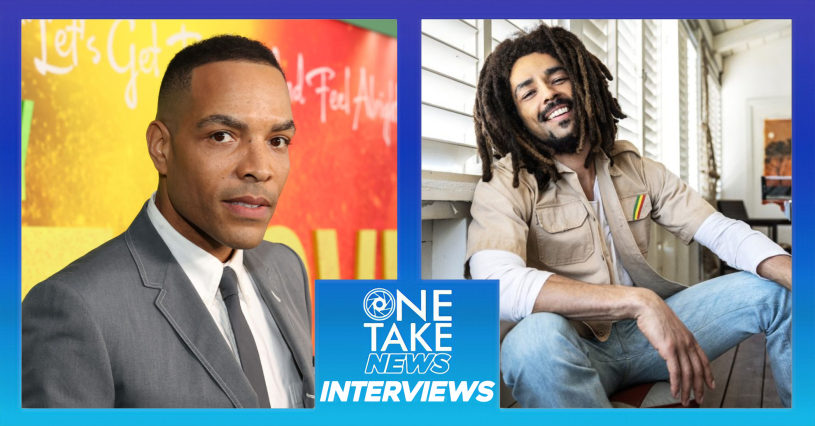
Reinaldo Marcus Green is a man who has been responsible for a slew of critical and commercial hits. In 2018, he broke into the scene with Monsters & Men, and followed it up with Oscar-winning film King Richard. This year, he tackles the story of one of music’s most iconic figures Bob Marley. We sat dow with Green and asked him about how he came about directing this movie, finding the right actor for Bob, and what compels him to consistently tell these empowering stories.
OTN: So the first question I really want to ask you is whenever someone undertakes a biopic, especially a music biopic, it’s really cool to know the relationship they had with the artist, music, or the artist even themselves beforehand. So I’m curious for you, did you have a relationship with Bob Marley’s music beforehand? And can you tell me a bit about that?
R.M.G: Yeah, I mean, I, you know, my dad was a musician. I mean, he was an attorney by trade, but he was a musician. He had music around the house. He played guitar. He was in a band in high school and he always had Bob around the house. It was just one of the things that we grew up with. And, you know, the albums I remember from a very early age. I don’t remember the first songs, but I remember. And, you know, oftentimes, I mean, even my name and namesake, Reinaldo Marcus Green, was after Marcus Garvey. Marcus Garvey is who Bob studied about the black liberation and moving, you know, black Americans back to Africa. And so, it was interesting in that my dad was conscious enough to do that and know that. And so in thinking about myself in this movie and why me and how, and I’m not Jamaican, but like all the influences that Bob had on my life. And I thought it was an important thing to lean into. Bob’s music is something that resonates with me deeply as a human being. This music is about unity and peace and love. And that universality is hopefully in my work. And so it felt like it chose me, man. I don’t know, it’s like a hard thing to describe. Like sometimes things come to you and you try not to question them too much. You know, there’s a reason why my phone rang and there was a script about Bob Marley in my inbox. I don’t know what. And then I have to try to understand that and say, am I willing to try to go on that journey of understanding that? And part of making any film is trying to understand yourself as a filmmaker, understand yourself and your voice in it? And what part do I play in this film?
OTN: I really like that. I really like the way you kind of just said you don’t question it much, kind of just happens. I think that’s a really cool way of looking at it. Something I really like that I’ve seen about this whole process of making this movie, first of all, before I say anything, Kingsley is great in this movie. And something I love that he said in an interview during the process of this movie, of making this movie. You guys had the big casting call, and then you went to him, and he’s like, do another search. He didn’t want to do it, and he’s like, just find someone else. And he’s like, no, we’ve already done that. And then he accepted the role, and he’s great in this movie. So I’m curious for you and also, like, and the studio in general, what was it that made you guys go straight to Kingsley to be like, hey, we want you to play this?
R.M.G: Well, I think Kingsley came to us. Kingsley submitted a tape. And so I don’t know if someone on his team forced him to do it, but all I received was a tape from a guy who I didn’t know. So I had looked at hundreds and hundreds of tapes and saw nobody that was close. And when I got Kingsley’s tape, I thought, oh, who is this guy? I start leaning into the tape. I start thinking, wow, he’s got presence. Now he’s got short hair. He doesn’t have dreads. He’s not Jamaican. So I’m just doing some mental math here. I’m like, hmm, he’s mixed race. I don’t know where he’s from, but he looks kind of Bob-ish and it’s there. And more importantly, what he’s doing on this tape is not a mimic of Bob. It’s an interpretation. He’s really smart. He’s charismatic. He’s got presence. He’s got a foundation for something there. And so I think that was it. It was. But look, you have to be. There’s three things that as a coach or, you know, I’m looking for in a player. You need somebody that has the ability. You need somebody that is willing and is able. And oftentimes you might get one of three or two of three, but you don’t get three of three. Submitting his tape showed me that he was willing. You don’t submit a tape if you don’t think you can do it. So even if he was scared, on that particular day, he sent in the tape. So I knew he was willing. And what his tape showed is that he was able. And so I had two of those three. And now the third step was to go on the journey with this guy and to say, can we do this thing together? Can we surround him with the right cast, with the right crew, with the family, with the right script? Can we build a performance? There’s several different ways to build a performance, but it’s in building that sort of culture of success. Can we surround Kingsley? And look, he had to do a tremendous amount of homework, a tremendous amount of deep emotional dive, and he did that brilliantly, amazingly.
OTN: You surrounded him with a great cast, great atmosphere, and you guys really pulled it off. He’s incredible in this movie. Something I love about this movie as well, it stuck out to me a lot, You tell the story in a very non-linear way. You’ve kind of got two timelines almost. You got Bob as like a kid slash teenager, and then you have him from like the exodus era. And I really liked that. You don’t see that in a lot of biopics where they go back and forth. It’s usually very linear. When did you guys realize in the process of like writing it or just like even the middle shooting, I don’t know if something changed, that telling the story in a nonlinear way was gonna benefit the movie overall?
R.M.G: I think I knew pretty early on. Now there were certain things that we shot that didn’t end up in the movie, so things move around. But I think early on, there was talk about how do we capture the spirituality of Bob, you know, beyond the lyrics. And so the visions that you see in the movie of young Bob running from the fire, running from the man on the horse, that was something that revealed itself over time, but kept it out of the traditional biopic language, because visions are exactly that. I mean, they’re just… You can’t really explain them. They’re just… They just happen, and you see things. And Bob was known to see things. And so we wanted to lean into those visions, because I thought it was an important aspect of Bob. That’s what made him special. Even though there’s a little shot, he’s reading Rita’s poem in one of the shots and it was known that he read poems. There were these little details about Bob that I learned and thought, how do we visualize them? How do we make them cinematic? How do we bring them, bring another dimension to this film that breaks it out of the traditional biopic? And there’s nothing wrong with those films. They’ve just done them before, you know, but we were trying not to paint by numbers. That’s not what this film is about. It’s not what Bob’s music is about. That’s not what he did. So we wanted the film to be a reflection of him and his life and his legacy and how best to do that. But he did make popular music and he did make music that lots of people like. So we leaned into those things too. He just did it in his own way. And so I think part of it was trying to balance those aspects of his life and his stardom and his iconography and try to blend them all together into something that was emotional and hopefully will stand the test of time like his music does.
OTN: I really like the way you put it, kind of looking into his life. And I have one more question before you go. I got to ask, you know, you have King Richard, that was your last movie. And that’s a story, you’re telling the story of a black man. You have One Love, another story of a black man, and then you had Monsters & Men in 2018. All three of these movies, an overarching theme through a lot of your movies is like telling these black stories. And a lot of them have themes of like telling social, like stories about social justice and empowerment. What compels you to keep telling these incredible stories and bringing them to life to the big screen?
R.M.G: Like you said, they’re incredible stories. Bob Marley was a homeless kid from the streets of Trenchtown that rose to be one of the greatest musicians to ever do it. Richard Williams raised five girls in Compton, two of which went on to become two of the greatest tennis players to ever do it. They’re just great stories. And I’m looking for the, any filmmakers looking for a great story, fiction, nonfiction. Most of the stories that we’ve seen are based on real people, whether it’s Killers of the Flower Moon, Goodfellas. They might not call them biopics, but they’re based in some reality. And that’s what I’m looking for, human stories that resonate with global audiences. And, you know, and I do that. That’s part of the task and fun and joy, you know, but I don’t know what’s next, you know, I’d love to make a modern day Rain Man or Jerry Maguire. I’d love to make a modern day Clockwork Orange or make a movie like Her or Moneyball or Foxcatcher. And I’d also love to make a big movie like James Bond or, you know, like, those are fun. E.T. was amazing. It changed my life. But so did Radio Flyer and so did Searching for Bobby Fischer. So any time I can get a real story and something that means something and that is impactful, something that I care about and can have an emotional reaction to, whether it’s Do the Right Thing or Good Will Hunting. Those are the movies that I’m looking for. But I don’t want to remake those movies. I want to make original stories. Not that I wouldn’t do a remake, but that’s not my first choice. I think there’s just a lot more to tell and a lot more ways to tell them. So that’s what I’m looking to do.
Bob Marley: One Love is available to buy or rent on Digital now!
 One Take News