
At first glance, Roofman sounds like the kind of true-crime adaptation designed to go down easy: a quirky real-life story, a charismatic lead, and just enough criminality to feel edgy without ever getting too dark. And for a while, the film plays exactly like that. But beneath its approachable surface, Roofman reveals itself to be something quieter and more contemplative — less interested in the mechanics of crime than in the strange emotional logic that allows a man to live above the world without ever truly belonging to it.
Based on the true story of Jeffrey Manchester, a former Army reservist who famously robbed McDonald’s restaurants by cutting holes through their roofs, Roofman frames its protagonist not as a mastermind or menace, but as an oddity shaped by loneliness, routine, and an almost childlike desire for control. Channing Tatum plays Manchester with surprising restraint, dialing back his usual movie-star charisma in favor of something more withdrawn and inward-looking. It’s one of his most effective performances in years — not because it demands attention, but because it refuses to.
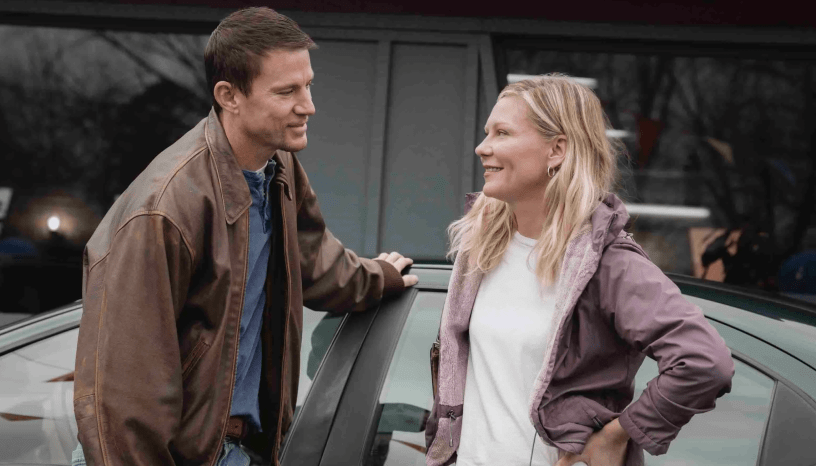
The film charts Manchester’s life on the margins: his meticulous planning, his unconventional methods, and his gradual entanglement with a single mother, played with warmth and grounded vulnerability by Kirsten Dunst. Their relationship becomes the emotional spine of the movie, offering a glimpse of the life Manchester might have lived if he were capable of staying still. Dunst’s performance is quietly essential — she brings texture and consequence to a story that could otherwise drift into romanticized eccentricity.
Director Derek Cianfrance approaches the material with the same patience and empathy that defined his earlier work. Roofman is not paced like a thriller; there are no breathless chases or elaborate heist montages. Instead, scenes unfold deliberately, often lingering past the point of narrative necessity. This rhythm mirrors Manchester’s own existence — repetitive, methodical, and oddly serene. The film isn’t asking you to root for his crimes so much as to understand the mindset that makes them feel inevitable.
Visually, Roofman leans into naturalism. The color palette is muted, the camera often handheld but unobtrusive, giving the film a lived-in quality that grounds its more eccentric elements. Rooftops, crawlspaces, and storage rooms become liminal spaces — neither fully hidden nor fully exposed — reflecting Manchester’s own limbo between freedom and isolation. The film finds poetry in these overlooked environments, suggesting that Manchester’s crimes are less about money than about carving out a space where he feels invisible and in control.
Where Roofman may frustrate some viewers is in its reluctance to interrogate its subject more aggressively. The film is empathetic to a fault, often skirting deeper ethical questions about accountability and harm. Manchester’s victims remain largely abstract, and the consequences of his actions are softened by the film’s gentle tone. For audiences expecting a sharper critique or a more conventional rise-and-fall arc, this restraint may read as evasive.
But that restraint is also the film’s defining choice. Roofman isn’t interested in moralizing or mythologizing. It’s interested in the quiet tragedy of a man who discovers a way to live that almost works — and the sadness that comes from knowing it can’t last. The film understands that some people don’t self-destruct in spectacular fashion; they simply drift until there’s nowhere left to land.
By the time Roofman reaches its conclusion, it hasn’t delivered a grand statement or a shocking revelation. Instead, it leaves you with a lingering sense of melancholy — the feeling of watching someone step out of alignment with the world, not out of malice, but because they never quite learned how to stay grounded within it.
 One Take News