
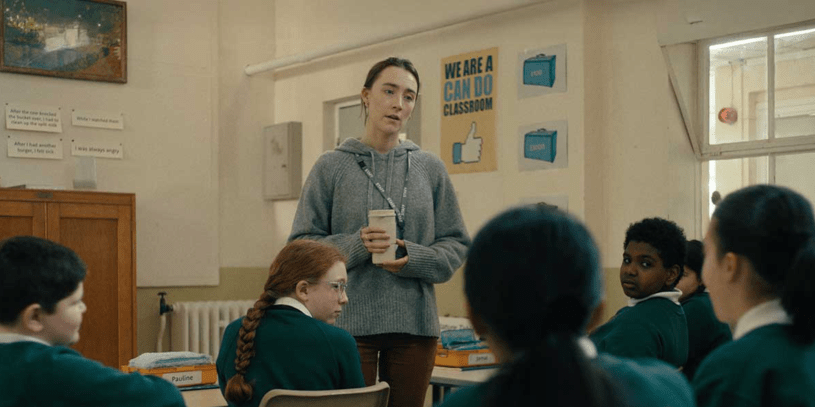
Bad Apples is a film that dares you to laugh, then quietly judges you only seconds later. A darkly comedic pressure cooker set almost entirely within the walls of an elementary school, the film takes a premise that feels ripped from a late-night “what if” conversation and commits to it with unnerving confidence. The result is a satire that is often hilarious and deliberately impossible to resolve cleanly.
At the centre of Bad Apples is Maria, a well-meaning but worn-down teacher whose patience has been eroded by years of institutional neglect. But, when one student’s behaviour pushes her past the point of reason, Maria makes a decision that is both shocking and absurdly human, which we will not spoil here. Needless to say, it will have your jaw on the floor.
What makes Bad Apples work as well as it does is its refusal to frame Maria as either a monster or a martyr. The movie understands that satire only cuts when it’s aimed in multiple directions at once. Yes, Maria’s actions are indefensible, we know this. But the movie is equally ruthless toward Maria as well as the systems surrounding her: administrators who speak in buzzwords, parents who weaponize concern, and a culture that demands emotional labor without offering any support. The laughter comes not from exaggeration, but recognition of the truth.
Tonally, Bad Apples walks a tightrope. Director and co-writer Jonatan Etzler leans hard into the discomfort, staging shocking scenes that linger just long enough for the humour to curdle into something closer to anxiety that will leave you squirming in your seat. The pacing is deliberate, almost confrontational. The silences stretch, reactions are delayed, and jokes often land a beat later than expected. It’s a strategy that pays off more often than not, and I appreciated this major risk.
The performances are crucial to sustaining that balance, and the cast largely delivers on all fronts. Maria is portrayed by 4-time Oscar nom Saoirse Ronan with an intensity that feels less like a breakdown than a slow erosion. Every choice she makes seems internally justified, even as the consequences spiral out of her control. The supporting cast, particularly the school administrators and parents, are drawn just broadly enough to be funny without tipping into caricature-like portrayals. The children themselves are treated with surprising restraint; the film resists turning them into punchlines, with some students getting the best jokes of the film.
Visually, Bad Apples keeps things grounded and claustrophobic. The school setting is shot in a way that emphasizes repetition and confinement. From the identical hallways, to the fluorescent lighting, and rooms that feel too small no matter how many people are in them. There’s no visual flourish to soften the blow of the subject matter. It’s an effective choice from cinematographer Nea Asphäll, even if it occasionally flattens the film’s visual energy.
Bad Apples isn’t an easy watch for many reasons, and it’s not meant to be. It understands the power of satire lies not in exaggeration, but in proximity, how close it can get to the truth before one can look away from the screen. It’s a sharp, and extremely unsettling dark comedy that weaponizes discomfort with precision. It won’t satisfy everyone, but for the right audience, it absolutely knows what it’s doing.
 One Take News