
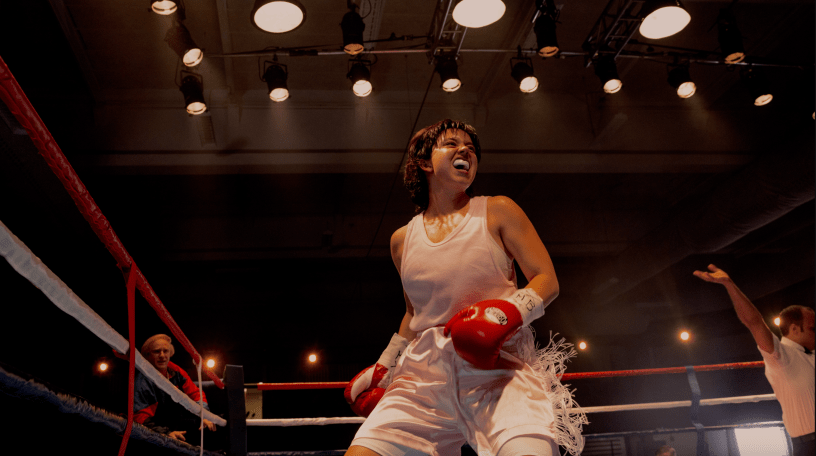
Christy is the kind of film that risks being overlooked precisely because it doesn’t announce itself loudly. There are no high-concept hooks, no showy stylistic flourishes, no obvious awards-bait performances engineered for highlight reels. Instead, it unfolds quietly, patiently, and with a deep respect for the interior lives of its characters. In a festival landscape often dominated by ambition and scale, Christy distinguishes itself through restraint — and, in doing so, earns its emotional weight the hard way.
The film centers on its title character, a young woman navigating a transitional period marked by grief, displacement, and the uneasy process of redefining herself outside of the roles she once occupied. The story is modest by design: Christy isn’t concerned with dramatic reversals or neat narrative closure. It’s about the slow, often uncomfortable work of recalibration — learning how to exist after something foundational has shifted.
What immediately stands out is the film’s commitment to specificity. Christy’s experiences are not generalized into broad metaphors about loss or resilience; they’re grounded in practical, everyday moments. Conversations trail off. Decisions are postponed. Emotions surface indirectly, through behavior rather than confession. This approach gives the film an authenticity that feels earned rather than performed.
The central performance is key to making this work, and it delivers with remarkable subtlety. Christy is played without overt signaling — there are no big emotional cues telling the audience how to feel. Instead, the performance relies on body language, timing, and silence. It’s the kind of portrayal that might not immediately register as “impressive” but grows more affecting the longer you sit with it. The character’s interiority is never spelled out, yet it feels fully present.
Direction is similarly restrained. The camera often keeps its distance, observing rather than intervening. Scenes are allowed to breathe, sometimes lingering on moments that would typically be trimmed for efficiency. This patience reinforces the film’s themes: healing is not linear, and clarity doesn’t arrive on schedule. The pacing may test viewers accustomed to more assertive storytelling, but for those willing to adjust their expectations, it becomes part of the film’s emotional language.
Visually, Christy opts for naturalism over polish. The environments feel lived-in — imperfect, slightly worn, and deeply familiar. There’s a sense that the world continues to exist beyond the edges of the frame, indifferent to the protagonist’s internal struggles. That indifference is quietly devastating, underscoring how personal upheaval often unfolds in spaces that offer no acknowledgment or pause.
Where Christy truly succeeds is in its refusal to impose meaning where it doesn’t naturally arise. The film doesn’t rush toward resolution or insist on transformation. Growth, here, is incremental and often invisible. By the final act, Christy hasn’t “figured things out” in any conventional sense — but there’s a subtle shift in how she occupies space, how she listens, how she allows herself to be present. The film trusts the audience to recognize that as progress.
That same restraint, however, may frustrate some viewers. Christy is so committed to understatement that it occasionally flattens its own dramatic potential. Certain relationships and conflicts feel underexplored, not because they’re unimportant, but because the film is hesitant to push them forward. There’s a fine line between minimalism and inertia, and Christy brushes up against it more than once.
Still, the film’s sincerity ultimately outweighs its limitations. In an era where emotional authenticity is often simulated through heightened drama, Christy offers something rarer: a portrait of a person simply trying to move forward without a roadmap. It doesn’t demand attention — it invites it.
Christy may not linger in the mind through bold images or quotable dialogue, but it leaves behind a quieter residue: recognition. For viewers attuned to its frequency, that recognition is more than enough. Christy is a gentle, character-driven drama that finds power in subtlety and trust. Modest in scope, but quietly affecting.
 One Take News