
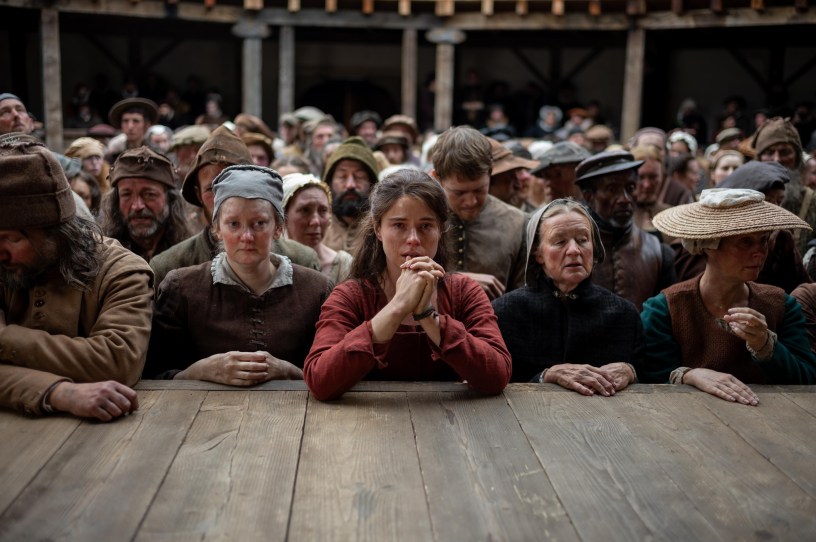
Chloé Zhao’s Hamnet is nothing short of a masterpiece that demands your attention. Zhao could have made a simple, conservative period piece rooted in literary afterlives but instead, she made a raw, elemental study of grief and how one lives through it, and shows the everyday devastation of a family undone.
Based on Maggie O’Farrell’s bestselling novel and co-writing the script with her, Hamnet is a loose adaptation of the story of Shakespeare and his family life. It doesn’t frame itself as a biopic of the legendary playwright. Instead, we see Jessie Buckley’s Agnes Shakespeare (loosely based on Shakespeare’s real wife Anne Hathaway) as the true heart and soul of the story, masterfully playing a woman deeply tied to the land and fragile rhythms of domestic life. Paul Mescal’s William Shakespeare isn’t yet the legend we know, but merely a young artist navigating rising success.
Right from the get-go, Hamnet announces itself as something more akin to lyric poetry than a conventional drama. Zhao, maintaining her distinctive style from Nomadland and The Rider, finds meaning in quiet glances between characters, lingering on the landscapes, and the sounds of wind through trees. Hamnet is substance and style merged together in the best way possible, and that’s what makes it special.
Hamnet’s narrative arc is also deceptively simple, as it tells the story of a marriage shaped by joy, separation, and the tragic death of a child. Beaneth this simplicity lies layers of complexities though. Zhao molds her film into a meditation on creativity and absence, mainly on how loss of a loved one can reshape language, memory, and ultimately, art itself. Zhao doesn’t shy away from the darkness at all, but she also refuses to dramatize it into a typical melodrama. Instead, Zhao portrays the grief as if it’s felt in the bones of the characters.
Let’s address the elephant in the room. One cannot talk about Hamnet without acknowledging the incredible performances that elevate it. Jessie Buckley delivers a performance of a lifetime, showcasing so many emotions without saying even a word sometimes. Her portrayal of Agnes is both fierce and fragile, and is easily the Oscar frontrunner. Paul Mescal’s William Shakespeare is watchful and at times extremely distant, caught between professional ascent and his personal collapse. Buckley’s chemistry with Mescal is the anchor of the film through and through.
Visually, Zhao collaborates with cinematographer Łukasz Żal (Zone of Interest) to capture Stratford-upon-Avon and its surrounding woodlands as more than settings, but as emotional landscapes. The rural environs are shot with such reverence that they function almost like another character in the film. Those lands are witness to fleeting joy, growing fear, and unanswerable questions about fate. This immersion is where Hamnet finds its resonance. It doesn’t just tell you how Agnes and William feel in the film., it makes you feel it.
Hamnet is an austere and unforgettable love story. It’s a film that confronts grief not as spectacle, but instead as enduring presence. It is not casual viewing, nor is it light, far from it honestly. But for those who are willing, it’s one of the year’s most rewarding theatrical experiences.
 One Take News