
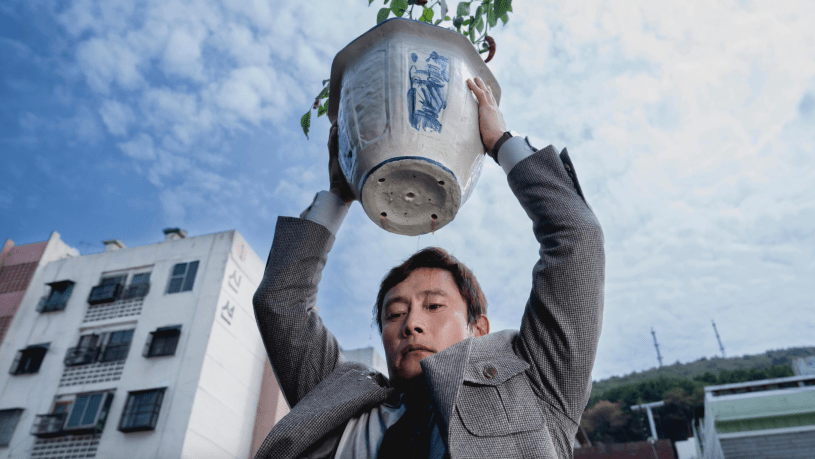
With No Other Choice, Park Chan-wook returns to familiar terrain: moral rot, systemic cruelty, and characters backed so tightly into corners that violence begins to feel less like a choice and more like an inevitability. But where much of Park’s most celebrated work leans into operatic intensity, No Other Choice opts for something colder and more controlled — a satirical thriller that weaponizes restraint as effectively as shock.
The film follows Man-su, a middle-aged factory worker abruptly laid off after decades of loyal service. His firing is not dramatic; it’s procedural, polite, and devastating in its banality. With few prospects, mounting debt, and a family that depends on his stability, Man-su finds himself suffocating under the quiet pressures of modern economic life. When a series of increasingly absurd opportunities present themselves, he begins to consider actions he once would have deemed unthinkable.
Park frames this descent not as a psychological break but as a logical progression. Each step Man-su takes feels, in isolation, reasonable — even justified. It’s only when the accumulation becomes visible that the film’s horror fully emerges. This is No Other Choice’s sharpest insight: desperation doesn’t arrive with a scream, but with a shrug.
Tonally, the film occupies a precarious space between bleak comedy and social indictment. Park’s signature dark humor is present, but it’s muted — jokes land with a dull thud rather than a punchline snap. Conversations linger uncomfortably, characters talk past one another, and moments that should offer relief instead deepen the sense of futility. The laughter this film provokes is uneasy, often delayed, and sometimes tinged with guilt.
Visually, No Other Choice is meticulously composed. Park’s control of framing and movement turns mundane environments — office lobbies, industrial spaces, cramped apartments — into sites of quiet menace. The camera frequently observes from a distance, reinforcing the sense that Man-su is being watched, judged, and discarded by systems far larger than himself. The color palette is drained and uninviting, a world leached of warmth long before violence enters the frame.
The central performance is essential, and it delivers. Man-su is portrayed with a subdued intensity that resists melodrama. His anger rarely surfaces openly; instead, it seeps into his posture, his silences, his increasingly transactional view of the people around him. This restraint makes the film’s later turns more unsettling — when brutality arrives, it feels less like escalation than conclusion.
Where No Other Choice may divide audiences is in its refusal to offer catharsis. The film doesn’t build toward a single explosive moment so much as a series of compromises that corrode the soul. Park isn’t interested in redemption arcs or moral lessons; he’s interested in exposure. By the time the film reaches its final act, the question is no longer whether Man-su has alternatives, but whether the idea of “choice” was ever real to begin with.
This thematic rigor, however, comes at a cost. The film’s deliberate pacing and emotional distance can feel punishing, particularly for viewers accustomed to Park’s more flamboyant stylization. There are stretches where the narrative seems to stall, circling its ideas without pushing them forward. Some may interpret this as a lack of momentum; others will see it as an intentional reflection of the protagonist’s paralysis.
Ultimately, No Other Choice is less about individual failure than collective complicity. It implicates corporations, governments, and audiences alike in the normalization of economic cruelty. By refusing to sensationalize its subject, Park crafts a film that lingers not because of what it shows, but because of what it refuses to resolve.
 One Take News